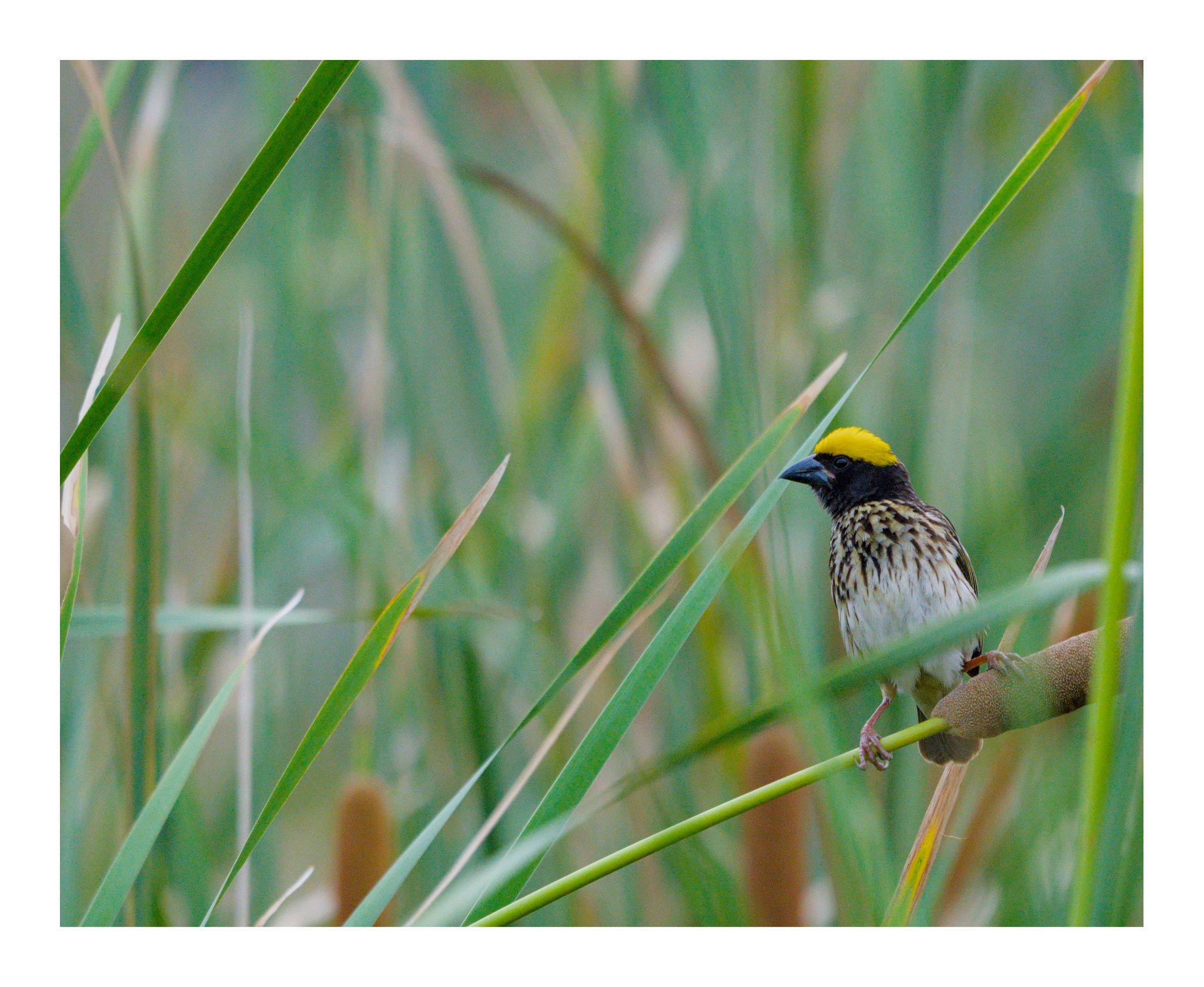
Watching a Streaked Weaver colony take shape—and asking whether these eastern birds were Ploceus manyar peguensis
On 23 May, I went to the nearest bird watching area near my house, in there a lot of reed beds were present and I always thought of getting weavers in that. Now on that day , the reed bed seemed to change character in a matter of hours. In the morning I first noticed two Streaked Weavers moving in and out of the reeds with a Baya Weaver nearby. By afternoon, the traffic had increased. A male was carrying fibres, stopping at selected reed leaves, and the first rough wad of a nest had begun to take shape.

Over the next five days I watched the construction advance through the recognisable early stages—from the initial wad to the ring and then the helmet. The number of Streaked Weavers using the area rose to roughly twenty individuals. Away from the nest sites they foraged with Tricoloured, White-rumped, and Scaly-breasted Munias, while Baya Weavers remained part of the wider reed-bed scene.
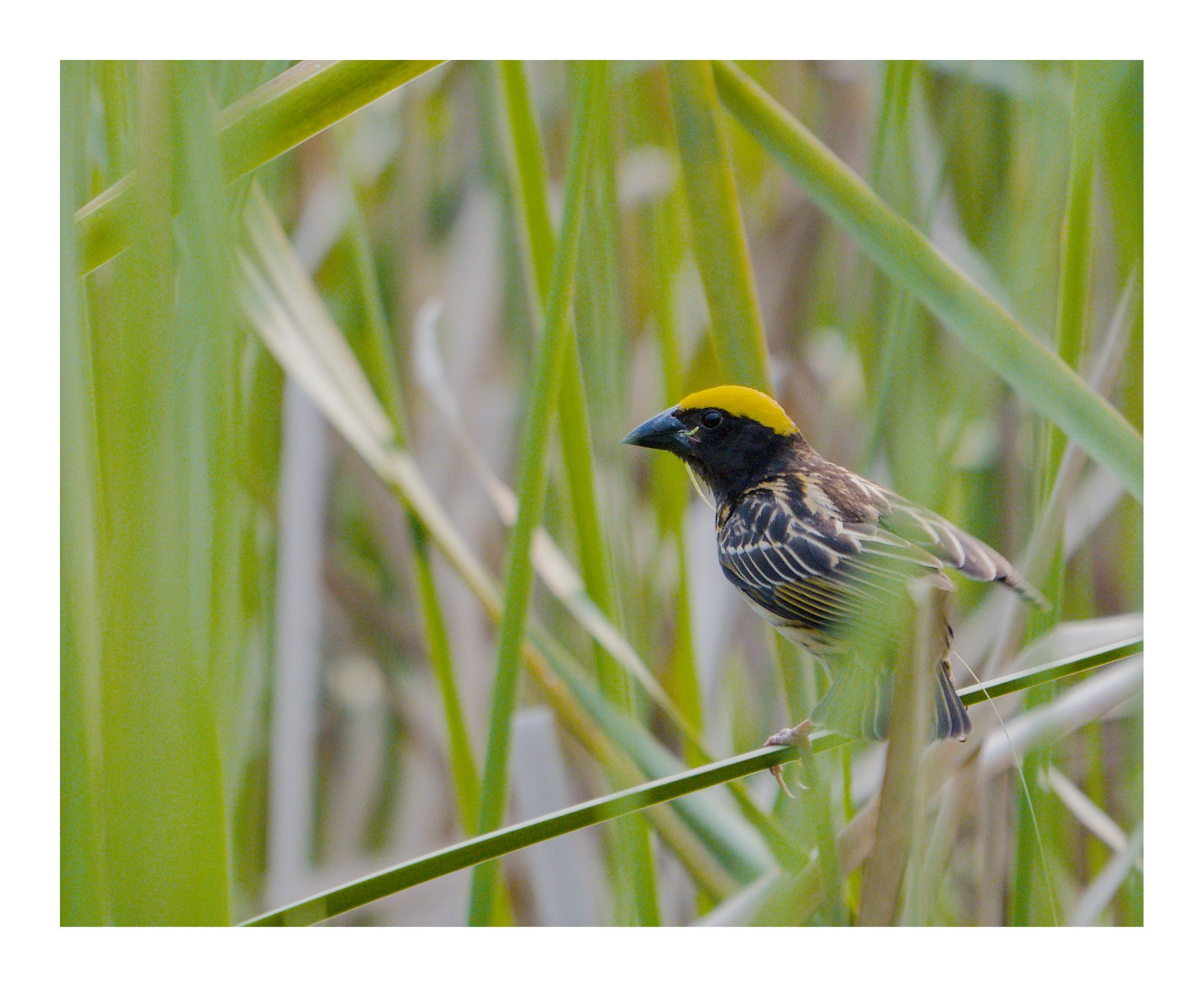
The most memorable behaviour was the male’s rapid wing-flickering display near the developing nest. By the end of a week the activity had moved into the sensitive courtship and nesting period. Because the reed bed lay beside a road, I stopped making regular visits rather than risk drawing attention to the nests or changing the birds’ behaviour. I did not observe the later egg-chamber, eggs, chicks, or fledging, so the eventual outcome of the nesting attempt remains unknown.
| OBSERVATION AT A GLANCE | FIELD NOTE |
|---|---|
| Period | 23 May and the following week |
| Habitat | Roadside reed bed in wet ground |
| Numbers | Two birds initially; about twenty later |
| Nest progress | Wad → ring → helmet stage observed |
| Display | Rapid wing-flickering by a male |
| Associates | Baya Weaver and three munia species |
| Later outcome | Not followed beyond the first week |
A bird made for the reeds
The Streaked Weaver is a compact, seed-eating weaver whose breeding male combines bright yellow with the dark streaking that gives the species its English name. Females and non-breeding birds are quieter in colour, and a mixed flock can be confusing when Baya Weavers and munias are moving through the same vegetation. Structure, streaking, bill shape, calls, habitat, and a sequence of photographs are more dependable together than any single feature.
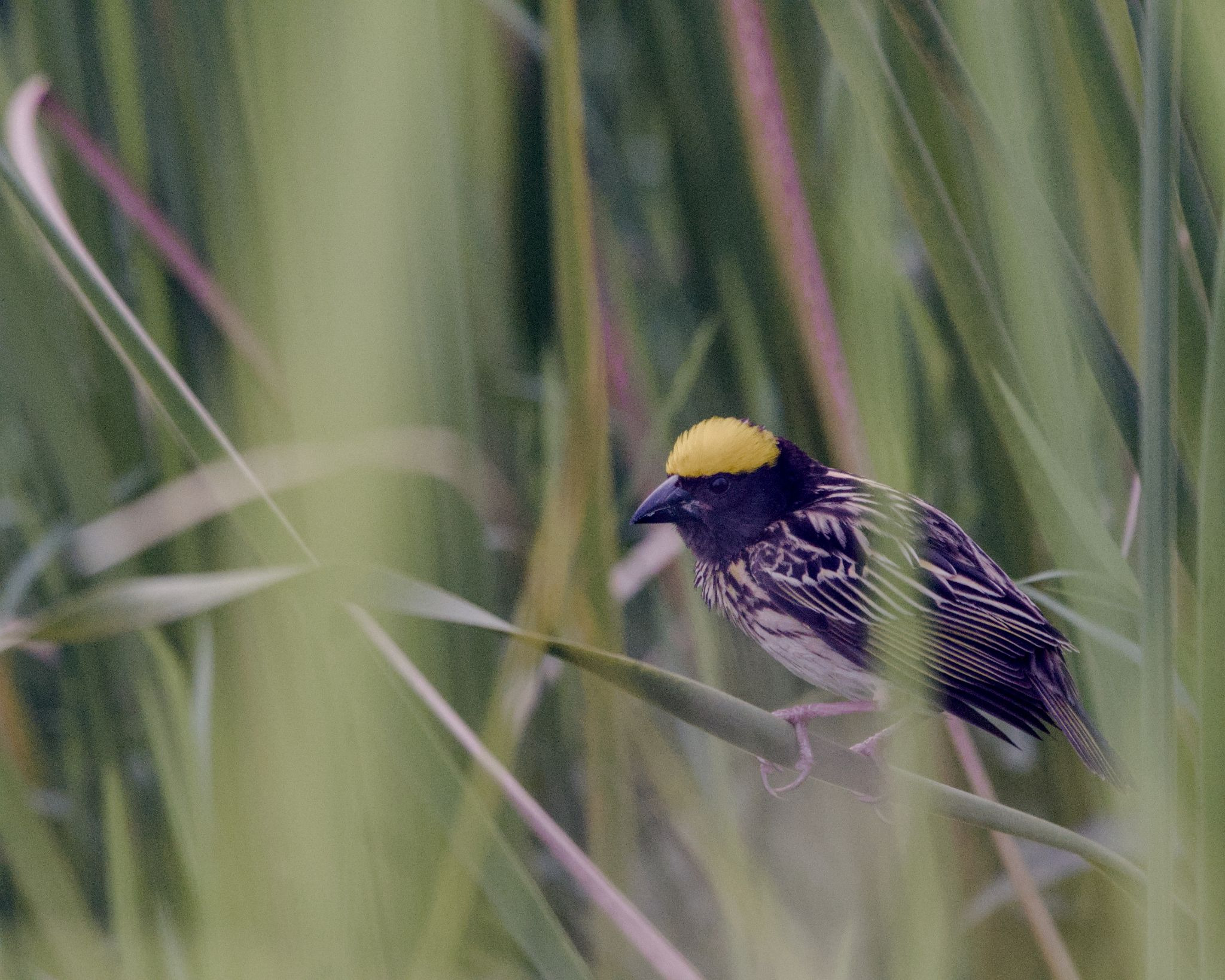
It is also a colonial nester. Several pairs may use the same patch of reeds, but a count of twenty birds does not equal ten breeding pairs or twenty active nests. Some individuals may be feeding, roosting, prospecting, or visiting from nearby. In a large study at Veedur Reservoir, Tamil Nadu, M. Pandian recorded 334 nests at different stages in eighteen colonies, with individual colonies ranging from four to sixty nests. My much shorter observation is best described simply as a small breeding aggregation.
A nest assembled in visible stages
Weaver nests look almost magical when finished, but their construction is easier to understand as a series of engineering problems. Recent Streaked Weaver studies use a useful five-stage vocabulary. The exact pace varies with the individual birds, weather, material, and whether a mate accepts the nest.
| STAGE | WHAT CHANGES | SEEN |
|---|---|---|
| Wad | Selected reed leaves are bent together and firmly bound; fibres build a compact roof or anchoring mass. | Yes |
| Ring | Weaving extends downward to form a loop beneath the roof. | Yes |
| Helmet | A helmet-like shell develops, with two lower openings separated by a fibre crossbar or ‘chinstrap’. | Yes |
| Egg chamber closed | After pair formation, one side is enclosed to create the brood chamber while an entrance remains. | No |
| Complete | The antechamber is finished and a short downward entrance tube is extended. | No |
In the wad stage the male draws together the flexible tips of several leaves and fastens them with knots of plant fibre. More fibres create the dense roof from which the rest of the structure descends. The ring stage produces the first unmistakable loop. Continued weaving turns that loop into a helmet with two openings and a narrow crossbar. This is not yet a complete nest; it is the display and inspection stage at which a female may examine the male’s work.
Modern observations at Wazirabad and Veedur report males building to the helmet stage and females helping after pairing, while V. C. Ambedkar’s older study in the Kumaon Terai described the male as the sole builder. That disagreement is worth preserving: sex roles may vary among populations, or differences in observation may reveal behaviour that shorter studies miss. It should not be flattened into the simple claim that only the male ever builds.
A CURIOUS CONSTRUCTION DETAIL
Older and modern observers have recorded males placing mud or cow dung on the inner wall of helmet-stage nests before pairing. The behaviour is real; its function remains uncertain. It is safer not to repeat unsupported claims that the material cools the nest, repels insects, or guarantees protection from predators.
The wing-flicker was courtship, not decoration
The wing-flickering I saw fits a long line of descriptions. In his 1963 comparison of Asian weavers, J. H. Crook described male Streaked Weavers quivering or beating the wings around the nest. Ambedkar likewise recorded males singing and quivering their wings as females moved through a colony and inspected helmet-stage nests. In Myanmar, W. L. Roseveare noted males hopping among the rushes and flapping their wings while females visited nests.
In the right context—a displaying male beside a helmet-stage nest, with females prospecting nearby—the movement is best read as nest advertisement and courtship. It does not, by itself, prove that a female accepted the nest or that mating occurred. In a field notebook I would record the visible action first (‘rapid wing-flickering beside helmet-stage nest’) and add the courtship interpretation separately.
A colony is also a neighbourhood
The Streaked Weavers did not use the reed bed in isolation. Their association with Tricoloured and White-rumped Munias closely echoes Pandian’s Veedur observations, where Streaked, Baya, and Black-breasted Weavers intermingled with munias while foraging and roosting. The Scaly-breasted Munias in my flock add a local detail rather than contradicting that pattern. Grain, grass seeds, insects, safe roosting cover, and nest material can bring several granivorous species to the same small wetland.
Nesting over wet ground may reduce access for some terrestrial predators, but these sites are not predator-proof. Published work records crows, treepies, shikras, and water snakes around colonies. The finished entrance tube may make access more difficult, but calling it ‘snake-proof’ would go beyond the evidence. Dense reeds provide concealment and support; they do not remove risk.
Does breeding always begin with the monsoon?
Breeding is often associated with rain, fresh grasses, and increased food, but ‘the breeding season begins when the monsoon starts’ is too absolute for a species spread across South and Southeast Asia. Ambedkar recorded breeding after the south-west monsoon began in the Kumaon Terai, and F. N. Betts described July breeding at a southern Indian tank. Other recent records are earlier: May–July at Wazirabad and February–June at Veedur.
The 23 May start at this reed bed is therefore plausible, not anomalous. Local water levels, the growth and flexibility of reeds, availability of weaving fibres, and nearby food may matter as much as the calendar date of the monsoon. A careful blog should say that breeding often follows favourable wet-season conditions while acknowledging that managed reservoirs, seepage wetlands, and local rainfall can shift the schedule.
Were these birds really peguensis?
My photographs and field impressions suggested the eastern subspecies Ploceus manyar peguensis rather than P. m. flaviceps. That identification should remain provisional unless the locality and plumage evidence agree. The current Nature Conservation Foundation synopsis places peguensis in eastern Bihar, south-western and northern Bengal, the Brahmaputra plains of Assam, and adjoining eastern Arunachal Pradesh. It notes intergradation with flaviceps in West Bengal.
The old BNHS literature fills part of the gap
The impression that Streaked Weaver breeding has been studied only in flaviceps is partly true for detailed modern Indian work. The well-known studies from the Kumaon Terai, Wazirabad, and Tamil Nadu all fall within the broad range usually assigned to flaviceps. Yet the eastern form is not absent from the historical record. E. C. Stuart Baker named P. m. peguensis in 1925 from Pegu, in present-day Myanmar.
Two older Journal of the Bombay Natural History Society papers are especially useful. K. C. Macdonald reported Streaked Weavers breeding in ‘kaing’ grass at Yezon Bog, Myingyan District, on 11 August. Roseveare later described very large numbers breeding in rushes at Wethigan Lake, Salin, and recorded males doing most or all of the building, females inspecting nests, wing-flapping display, and mud or dung on the inner rim of incomplete nests. These observations come from the wider region now associated with peguensis and offer valuable behavioural comparisons.
There is one important limitation: Macdonald’s account predates Baker’s subspecies name, and both older authors wrote about the species mainly under the binomial rather than documenting diagnostic subspecific characters. Their birds should therefore be described as regional Streaked Weaver records from the peguensis part of the range—not automatically treated as formally verified subspecies studies. That distinction makes the literature review stronger, not weaker.
What this seven-day observation can—and cannot—show
This short watch does not establish clutch size, incubation, nest success, polygyny, or chick-rearing for the local population. It does document a useful combination of facts: the date breeding activity began, the reed-bed setting, the change from two birds to a larger aggregation, the rapid progression from wad to helmet stage, a male display, and mixed-species foraging. If the birds are confirmed as peguensis those details become a valuable eastern comparison with the better-known flaviceps accounts.
For comparison, Ambedkar’s flaviceps population most often laid three eggs, had an incubation period of fourteen to seventeen days, and included polygynous males. These are useful reference points, not facts that should be transferred automatically to peguensis.
Stopping after seven days was part of the observation, not a failure to finish it. Indian nesting-study guidelines emphasise distance, restraint, and the possibility that repeated visits or photography can change adult behaviour and predator attention. For any future watch I would use a fixed distant viewpoint and a long lens, avoid playback, never bend or cut reeds for a clear photograph, leave immediately if adults alarm or hesitate, and keep the precise location private while the colony is active.
The week ended without a neat conclusion. The nests were still unfinished, the birds were still choosing and displaying, and the later fate of the colony was left to the reeds. What remained was a compact natural-history story: two weavers arriving on 23 May; fibres tied into a wad; a ring becoming a helmet; a male’s wings flickering in invitation; and an observer deciding that the best final act was to step away.
Comments