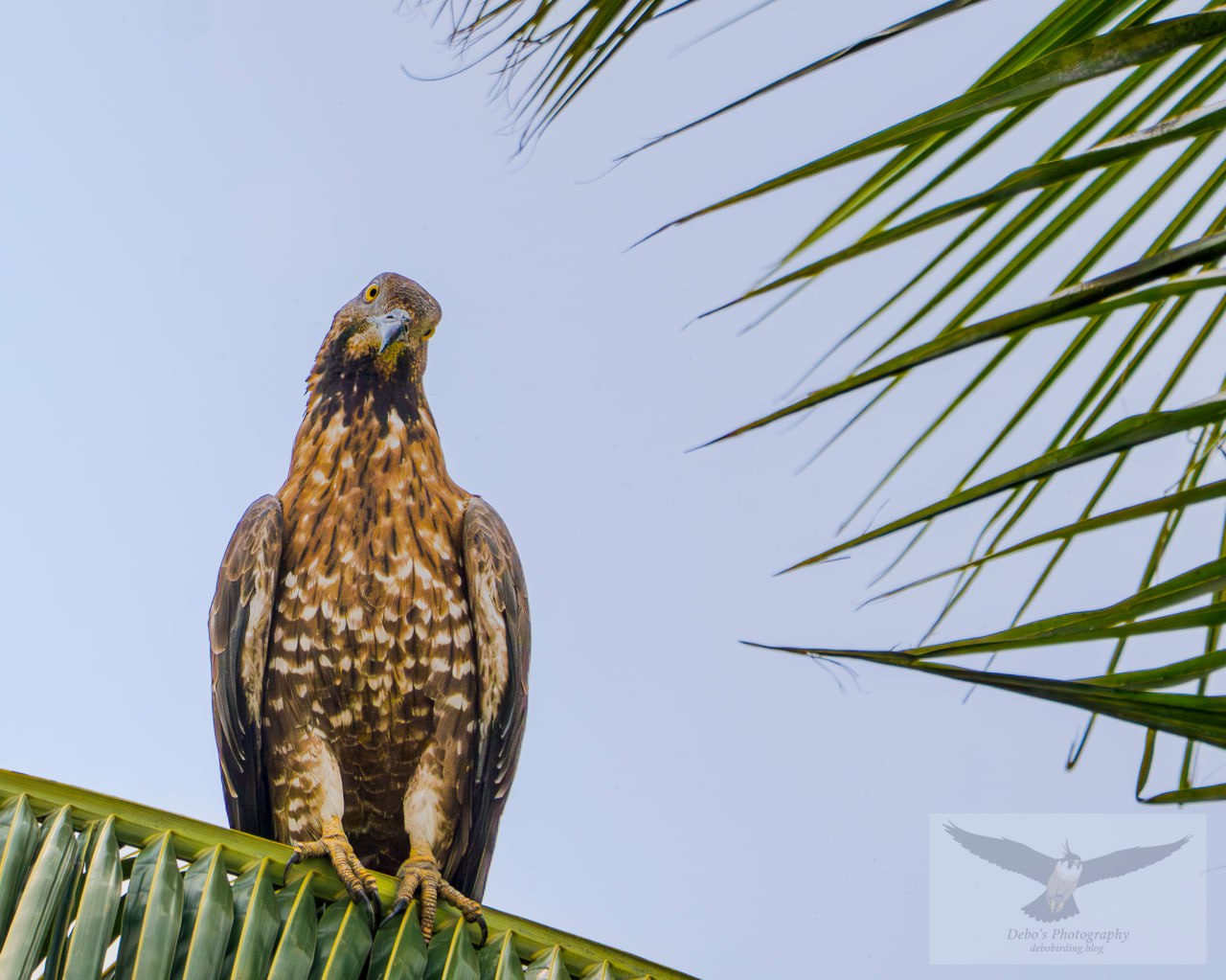
The Oriental Honey Buzzard (Pernis ptilorhynchus) is a fascinating, large raptor widely distributed across the Indian Subcontinent and Asia. In my home region of Hooghly, West Bengal, it is a common sight throughout the year. However, despite its frequency, capturing a high-quality photograph has always been an elusive goal for me—until February 26th.
While I have seen this bird countless times in flight, perched sightings are rare, numbering only four or five in my experience. On a beautiful February morning, the ‘guest’ finally paid a visit to our home. While I was scanning the nearby trees, my mother spotted this magnificent raptor perched regally on a coconut tree. I rushed for my camera, and finally, I was able to document this beautiful bird of prey.
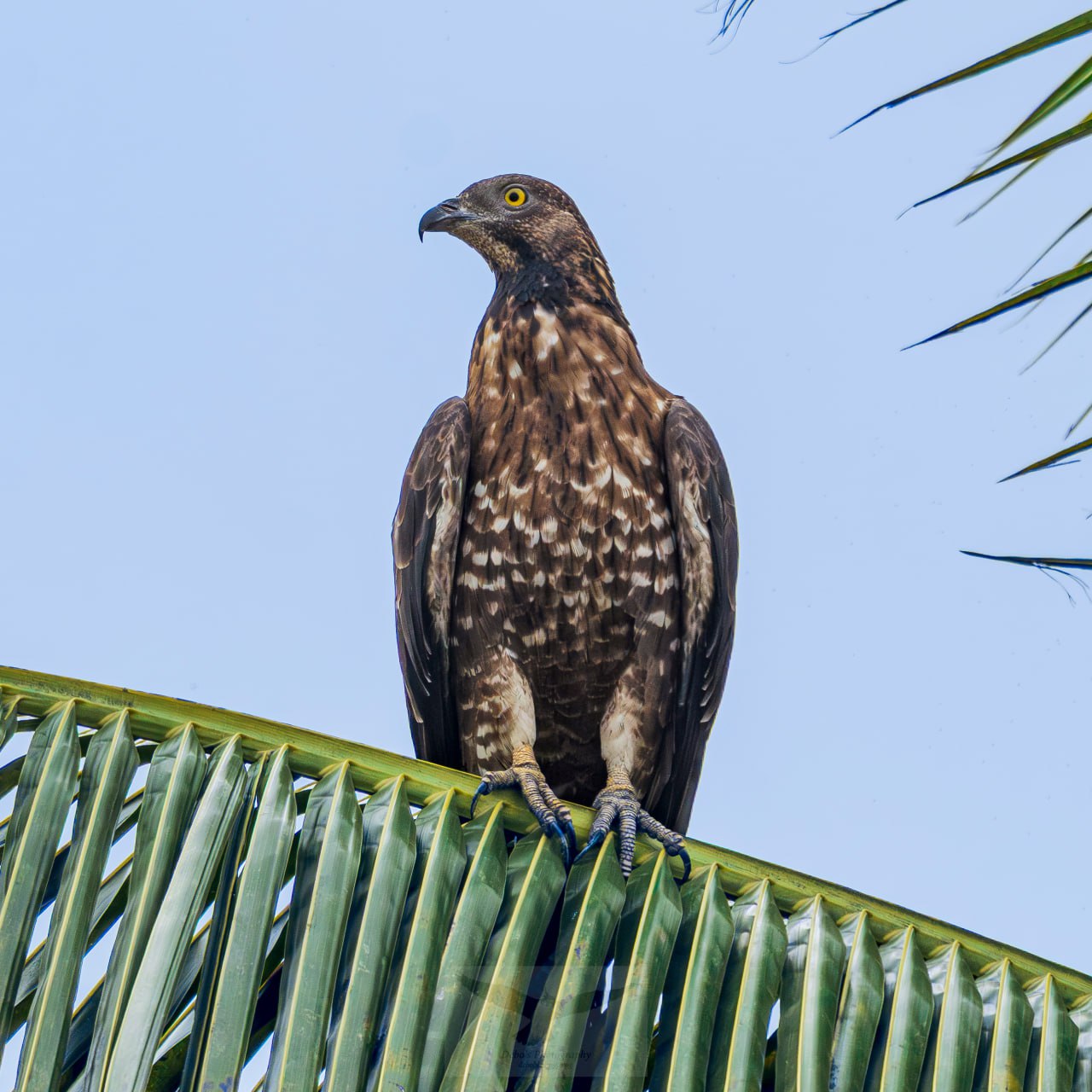
Why “Honey” Buzzard?
As its name suggests, this bird specializes in feeding on the larvae and nests of social insects, particularly bees and wasps. Its unique morphology, including scale-like feathers around the eyes and lores, protects it from stings while it raids hives.
The Identification Challenge: Subspecies and Morphs
One of the most compelling aspects of birding in India is the overlap of different subspecies. We have two primary forms:
- Race orientalis: A large, long-winged migratory subspecies that arrives in winter. It is generally pale and lacks a prominent crest.
- Race ruficollis: The native, resident subspecies. It is shorter-winged, darker, and possesses a distinct short crest.
Distinguishing between these two, as well as between males and females, requires a keen eye for detail. Since the individual I photographed is a female, I will focus on the specific markers that define the adult female Oriental Honey Buzzard (OHB).
Female Identification Key
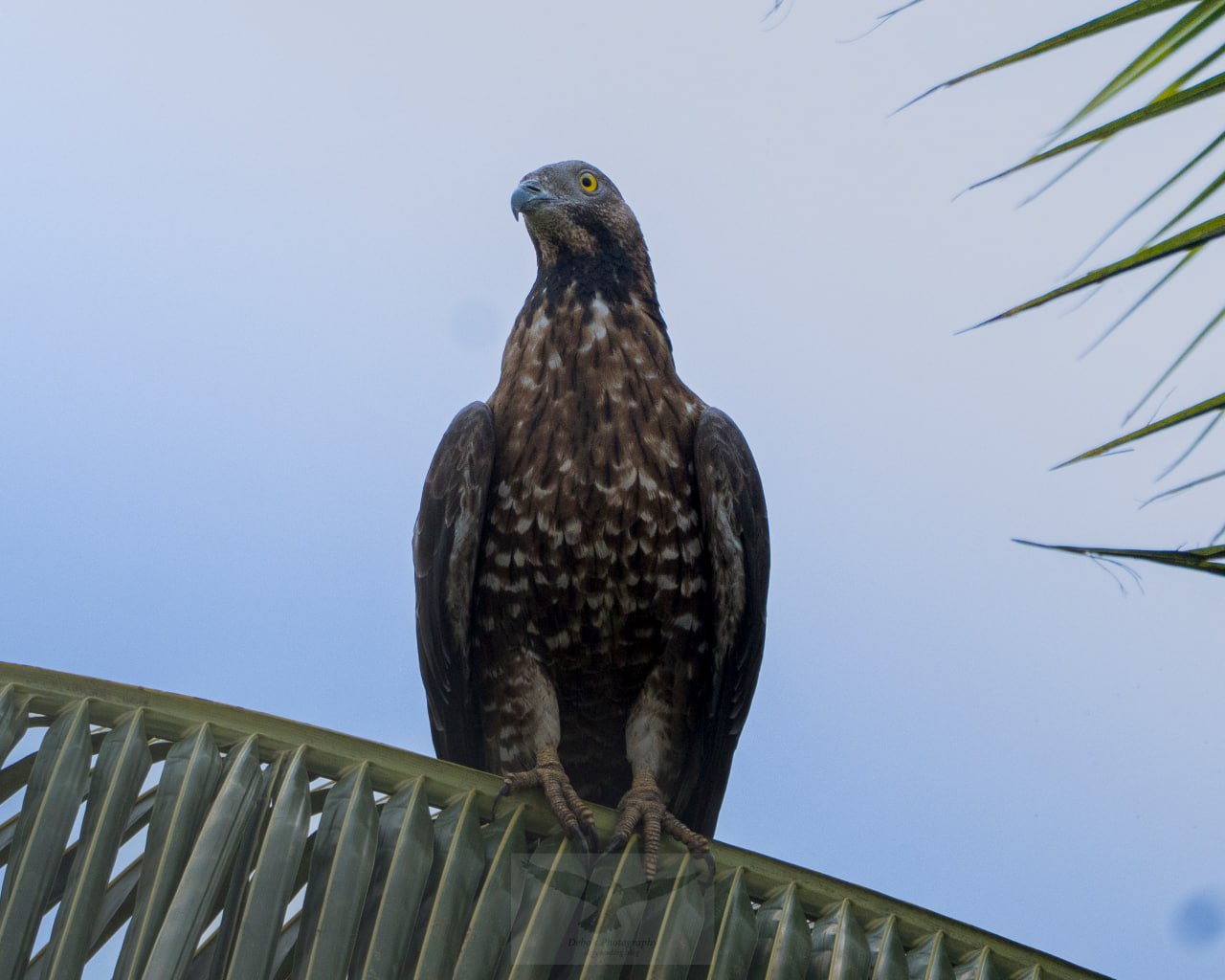
Identifying a female OHB involves looking at soft parts, plumage patterns, and wing structures:
- The Eye (Iris): This is a primary identification feature for determining between male or female. Adult females develop a bright yellow or orange-yellow iris. In contrast, adult males typically have dark brown or cherry-red eyes.
- Head and Throat: The female’s head is usually browner than the blue-grey head of the male. A key diagnostic feature is the heavy, broad black “gorget” (a necklace-like band) framing a pale throat.
- Plumage Morphs: Females are polymorphic, appearing in light, intermediate (rufous), and dark morphs. Unlike juveniles, which are streaked, adult females are consistently and heavily barred on their underparts.
- The Tail: Look for three visible dark bands. In females, the light sub-terminal band is often the broadest, while the black terminal bar is the widest of the dark bands.
Wings and Structure
In flight or when stretching, the wing formula is telling. Like males, females show six protruding “fingered” primaries ($P10$ to $P5$). However, when viewed from below, females show four narrow black wing bands across the secondaries, whereas males show only three broader bands.
Comparing the Races: orientalis vs. ruficollis
The migratory orientalis is significantly larger (wingspan up to 170 cm) and generally flat-headed. Our resident ruficollis is smaller (wingspan up to 155 cm) and usually displays a short, well-developed nuchal crest. While orientalis often shows a greyish wash on the head, ruficollis usually maintains a uniformly brown head with a dark horseshoe-shaped spot on the crop rather than a full gorget.
Footnote for Male Identification: Adult males differ by having a blue-grey head, dark red or brown eyes, broader and fewer wing bands, and a solid broad black trailing edge to the wing.
Capturing these photos was not just a win for my portfolio, but a great opportunity to dive deep into the complex taxonomy of one of our most interesting local raptors.
References (APA 7th Edition)
Anand, V., Aiyappa, P., Pavukandy, U., & Forsman, D. (2020). The European honey-buzzard Pernis apivorus in India, and notes on its identification. Indian Birds, 16(2), 45–47.
Babbington, J., & Campbell, O. (2016). Recent status and occurrence of crested honey buzzards Pernis ptilorhynchus in the Arabian Peninsula, with emphasis on Saudi Arabia and the United Arab Emirates. Sandgrouse, 38(1), 12–22.
Borang, A. (2013). Checklist and status of birds of Arunachal Pradesh in Eastern Himalayas. Bulletin of Arunachal Forest Research, 28–29(1–2), 19–54.
DeCandido, R., Siponen, M., Smit, H., Pierce, A., & Allen, D. (2015). Flight identification and migration pattern of the Oriental honey buzzard Pernis ptilorhynchus orientalis in southern Thailand, 2007–2014. BirdingAsia, 23, 27–33.
Nourani, E., Yamaguchi, N. M., Manda, A., & Higuchi, H. (2016). Wind conditions facilitate the seasonal water-crossing behaviour of Oriental honey-buzzards Pernis ptilorhynchus over the East China Sea. Ibis, 158(3), 506–518.
Pohlen, Z. M., Johnson, J. A., Benter, R. B., & Helm, J. (2026). First North American record of the Oriental honey-buzzard (Pernis ptilorhynchus). North American Birds.
Sievwright, H. C., & Higuchi, H. (2011). Morphometric analysis of the unusual feeding morphology of Oriental honey buzzards. Ornithological Science, 10(2), 131–144.
Yang, S.-Y., Walther, B. A., & Weng, G.-J. (2015). Stop and smell the pollen: The role of olfaction and vision of the Oriental honey buzzard in identifying food. PLOS ONE, 10(7), e0130191. https://doi.org/10.1371/journal.pone.0130191
Technical Reports and Compilations
Anonymous. (2024). Comprehensive taxonomic and morphological analysis of female Pernis ptilorhynchus: Differentiating orientalis and ruficollis subspecies.
Gavrilov, E., & Gavrilov, A. (2005). The birds of Kazakhstan (Abridged ed.). Tethys Ornithological Research II.
Regional Guides and Online Databases
Bird Society of Singapore. (n.d.). Crested honey buzzard. Birds of Singapore. Retrieved March 1, 2026, from https://singaporebirds.com/species/crested-honey-buzzard
Birds of Kyrgyzstan. (n.d.). Crested honey-buzzard (Pernis ptilorhynchus). Retrieved March 1, 2026, from https://kyrgyzstan.birding.day
Birds of Siberia. (n.d.). Crested honey-buzzard (Pernis ptilorhynchus). Retrieved March 1, 2026, from https://siberia.russia.birding.day
Macaulay Library. (2024). ML621190696 – Oriental honey-buzzard (Pernis ptilorhynchus). Cornell Lab of Ornithology.
Wikipedia contributors. (2026). Crested honey buzzard. Wikipedia. https://en.wikipedia.org/wiki/Crested_honey_buzzard
Field Research and Ornithological Blogs
Corso, A. (2013). Analysis of photographed crested/Oriental honey-buzzards in Batumi. Batumi Raptor Count.
Ooi, R. (2019). Wintering raptors in Peninsular Malaysia. Ron-Nature-Adventures.
Wee, Y. C. (2009). Oriental honey-buzzard came a-visiting. Bird Ecology Study Group.
Wee, Y. C. (2022). Oriental honey-buzzard: Sexing and aging. Bird Ecology Study Group.
Comments